
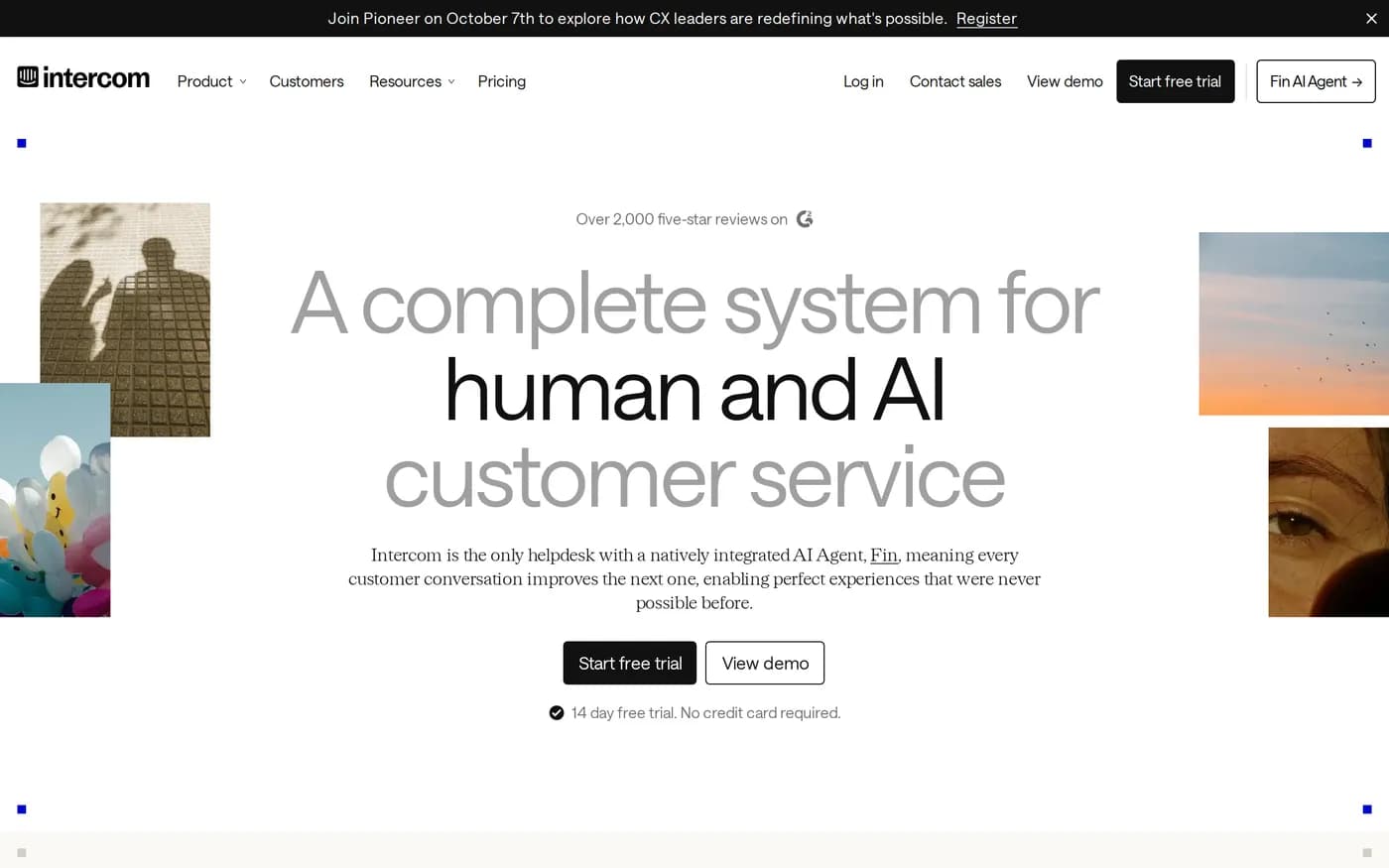
Almost every software vendor in this review has bolted AI onto an existing price and asked you to pay more for the possibility of value. Intercom did something harder: it priced the outcome.

How Fin is billed
Fin, Intercom's AI agent, costs $0.99 per resolution. A resolution is a conversation Fin handled to a conclusion without a human. If it hands off, you pay nothing for that attempt.
That inverts the usual incentive in a way worth being explicit about:
Under per-agent pricing, the vendor is paid the same whether AI works or not.
Under per-resolution pricing, the vendor is paid only when it does.
It is the only pricing model in this entire round-up where the vendor loses money when its AI underperforms, and that alone deserves credit.
Compare the arithmetic. A support agent handling 800 tickets a month at a fully loaded cost of $4,500 is about $5.60 a ticket. Fin at ninety-nine cents is roughly a sixth of that. If Fin resolves 40% of your first-line volume, the saving is real and it appears in the month it happens rather than after a headcount decision.
The seat prices, which are not cheap
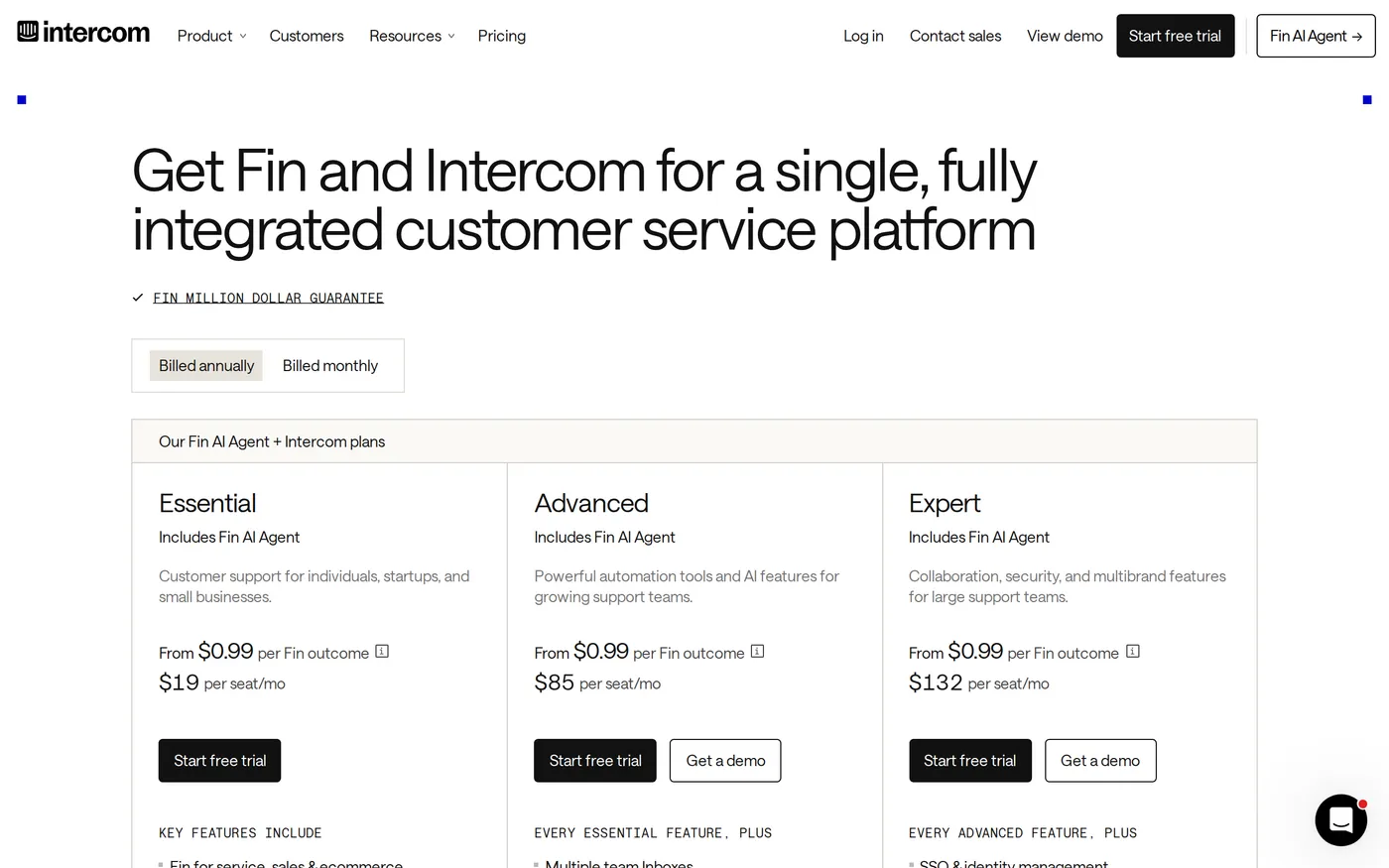
Essential —
$29per seat per month. Fin for service, sales and ecommerce; messenger; shared inbox; ticketing; prebuilt reports; public help centre.Advanced —
$85per seat. Multiple team inboxes, workflow automation, round-robin assignment, private and multilingual help centre, 20 free Lite seats.Expert —
$132per seat. SSO and identity management, HIPAA support, SLAs, multibrand messenger and help centre, 50 free Lite seats.
Expert at $132 is the highest per-seat figure anywhere in this review, above Zendesk Suite Professional at $115 and well above HubSpot Sales Hub Professional at $90.
The Lite seats materially change the comparison though. Twenty free Lite seats on Advanced means twenty colleagues — engineers, product managers, account leads — can be pulled into conversations without a full licence. In a company where support regularly needs an engineer to look at something, that is worth more than the feature list suggests.
The forecasting problem
Outcome pricing is fairer and harder to budget. Your monthly bill is now a function of conversation volume, which moves with your marketing, your release schedule and your bugs. A bad deployment that generates two thousand extra conversations produces a support bill you did not approve.
There is a second-order version of this that catches people. Improving your help centre content makes Fin better at resolving, which increases resolutions, which increases the bill — while reducing human workload. That is the system working as designed, and it still looks alarming on a finance report if nobody explained it in advance.
What to do about it
Model three scenarios before you commit: current volume, current volume plus 50%, and double. Calculate the Fin cost at each and compare against the human cost you would otherwise carry. If the model only works at today's volume, it does not work.
Fin as a standalone product
Underrated detail: Fin can be attached to an existing helpdesk at the same $0.99 per resolution, with a minimum monthly commitment and no seat requirement.
So a company running Zendesk can put Fin in front of it without migrating. That is a serious competitive move — it lets Intercom sell into accounts it would never win on a platform replacement, and it lets you test the AI economics without a migration project. If you are on Zendesk and curious, this is the cheapest experiment available.
Where Intercom is weaker than Zendesk
Reporting. Intercom's analytics cover the obvious questions competently and stop well short of Zendesk Explore. If your support organisation runs on workforce planning and segmented performance reporting, this will frustrate you within a quarter.
Process modelling. Intercom's workflow automation is good; Zendesk's triggers, SLA policies and skills-based routing can encode more complicated organisational rules. Intercom suits a support team that is fast and flat; Zendesk suits one that is tiered and formal.
Who should buy it
The profile is specific: a product-led company with high conversation volume, a substantial proportion of which is repetitive and answerable from documentation. SaaS, marketplaces, fintech onboarding, ecommerce support. If 40% or more of your tickets are questions with a documented answer, Fin will resolve a large share of them and the economics work.
If your support is low-volume and high-complexity — enterprise accounts, bespoke implementations, regulated advice — the AI resolves little, you pay top-of-market seat prices for a shallower reporting stack, and Zendesk or a cheaper shared inbox is the better buy.
Verdict
7.9. The pricing model is the best thing in this category and the seat prices are the worst, which averages out to a product that is excellent for a well-defined group and expensive for everyone else.
Before anything else, measure what share of your tickets are answerable from your existing help centre. That number decides this purchase. If it is high, trial Fin standalone against your current helpdesk — it costs a fraction of a migration and tells you the answer. Current plans are on Intercom's pricing page.
Softmarque is not paid by the products it reviews. Prices and plan names were taken from the vendor’s own pricing page on the date shown above and change often; nothing here is financial, legal or accounting advice.