
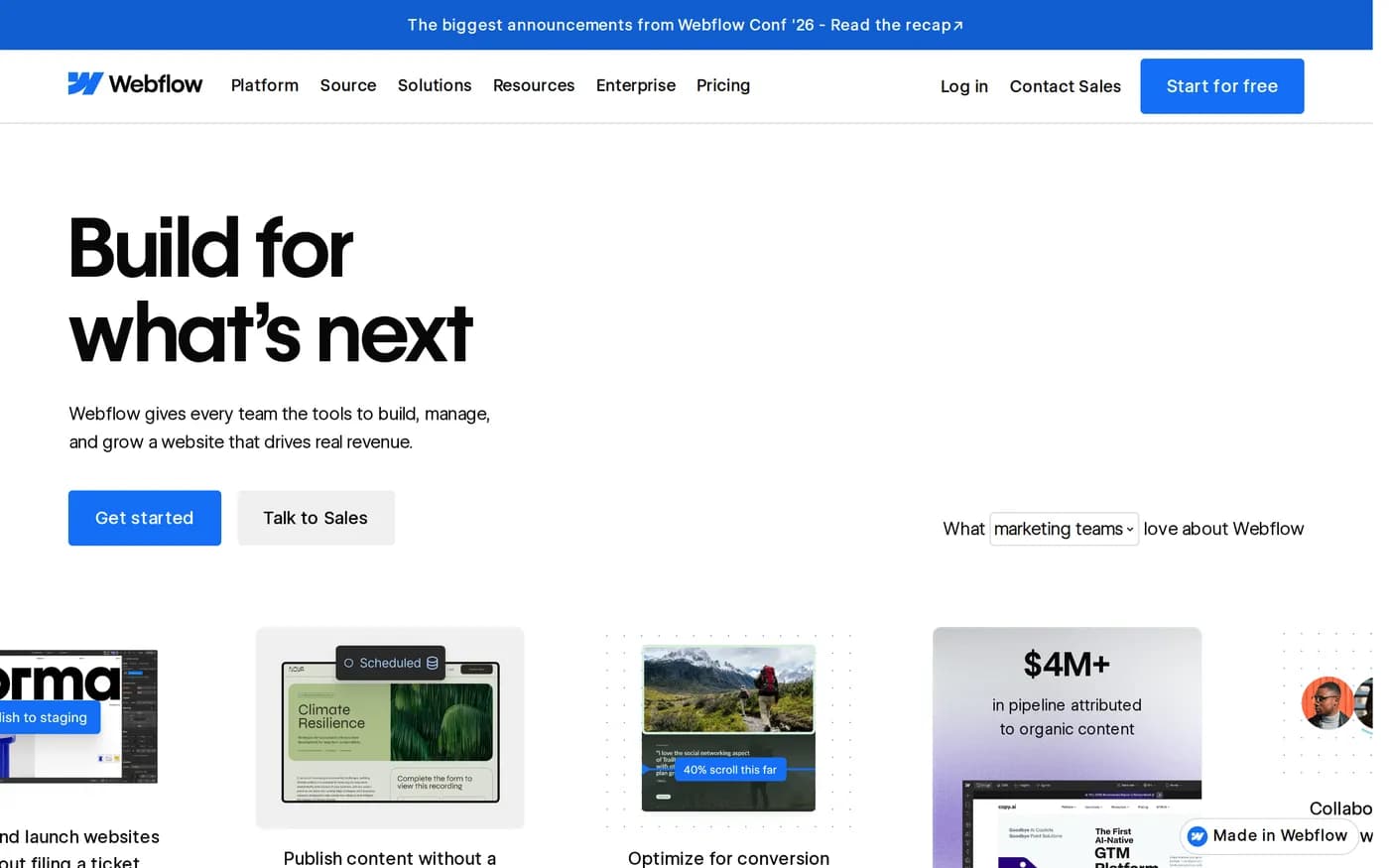
Start with the structural fact, because every other Webflow review buries it: there are two bills. A Site plan for each published website, and a Workspace plan for the people who build it. They are independent and they add up.
People discover this at the worst possible moment — after building a site, when they try to publish it to a real domain. The design work is done, the switching cost is sunk, and the number is higher than the one they planned around.
What May 2026 changed
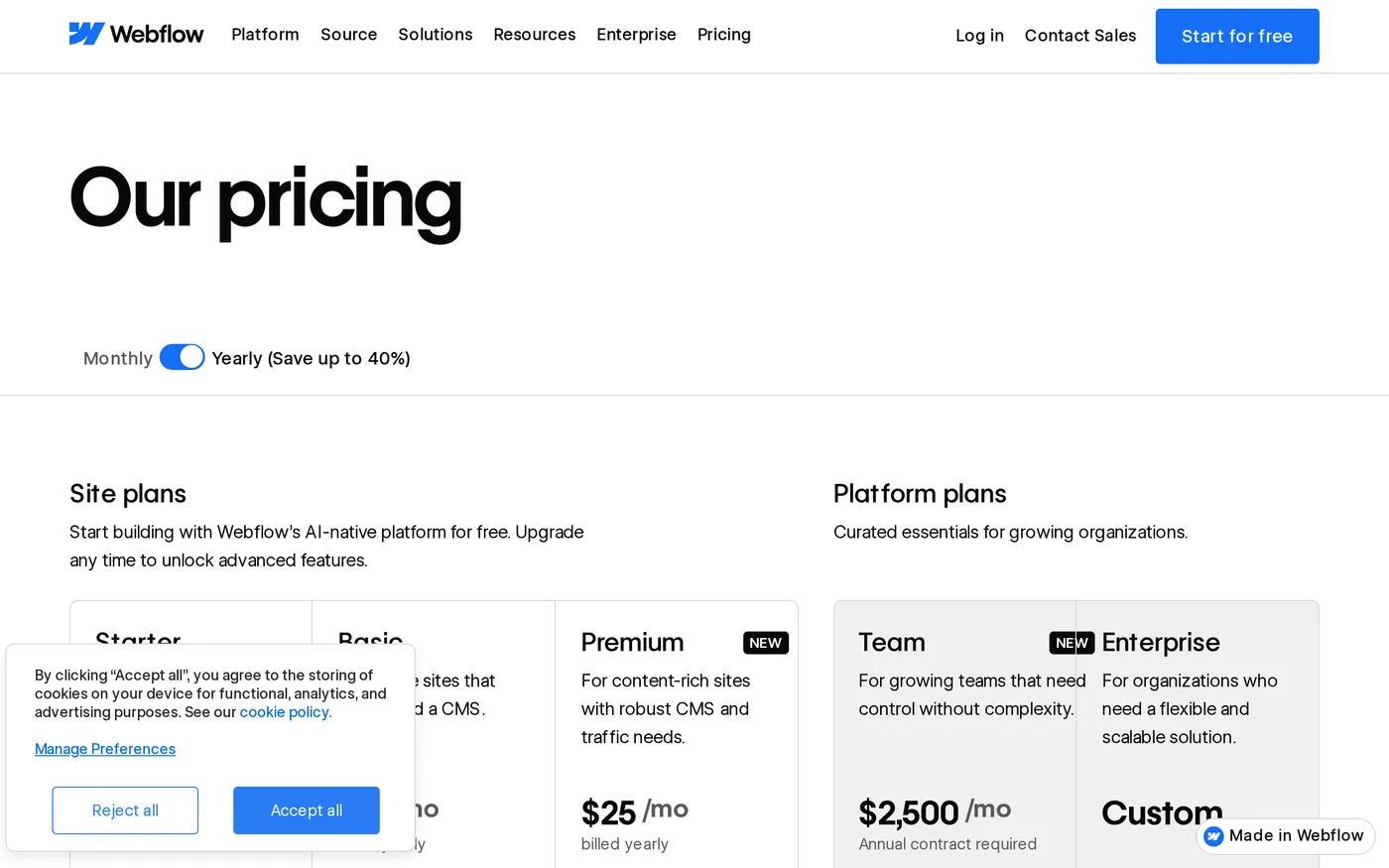
In May 2026 Webflow replaced the old CMS and Business site plans with a single Premium tier. The current site plans are:
Starter — free. A webflow.io subdomain, no custom domain.
Basic —
$15a month billed yearly. Custom domain, no CMS.Premium —
$25a month billed yearly.20,000CMS items and40collections.
This is a genuine improvement. The old structure forced people onto the Business plan for form submission volume or bandwidth they did not need, and the CMS limits on the cheaper tier were tight. Twenty thousand CMS items on a twenty-five dollar plan is generous and covers almost any marketing site.
The restructure made the table easier to read. It did not address the thing that actually confuses people, which is that the table is only half the price.
The other half
Workspace plans cover the people who build:
Starter — free, for a single builder with limited projects.
Core —
$19per seat per month.Growth —
$49per seat per month.
Beyond the base allowance, seats are priced by type: a Full seat at $39 a month can build and publish, a Limited seat at $15 can edit content, and a Free seat at $0 can review and comment.
A worked example
A marketing team with two builders, two content editors and one site: $25 for the Premium site plan, plus a Growth workspace at $49 a seat for two people, plus two Limited seats at $15. That is roughly $153 a month, or $1,836 a year — for one website.
Compare that with WordPress on managed hosting at $30 a month with unlimited editors. Webflow is five times the price and worth it only if the design freedom and the absence of plugin maintenance are worth that difference to you. Sometimes they emphatically are; the point is to make the comparison with the real number.
The free seat is the good idea
Credit where it is due. Stakeholders who need to look at a staging site and leave a comment cost nothing. In most of this category, the person who only ever says "can the headline be bigger" occupies a full licence, and organisations respond by not giving them access, and the feedback arrives by email instead.
Who Webflow is genuinely for
A marketing team that redesigns its site more than once a year and cannot get engineering time. Webflow removes the dependency entirely: a designer builds and publishes without a ticket, and the result is clean, fast and hosted with nothing to patch.
That is a real category of customer and for them Webflow is excellent. The design freedom is the actual differentiator — there is no template ceiling, no fighting a theme, no plugin that half does what you want. If you can draw it, you can build it.
Who it is not for
Anyone with an engineering team. Give them a static site generator and a repository. It will cost less and version properly.
Blog-first publishers. WordPress remains better at editorial workflow, and considerably cheaper for many authors.
People who want to avoid learning CSS. Webflow's designer is a visual interface onto the box model. Without understanding flex, grid and inheritance you will produce something that breaks at 768 pixels.
Ecommerce at scale. Read the Shopify review in this section; this is not a close contest.
The Team plan gap
Webflow also offers a Team plan at $2,500 a month on an annual contract, bundling a site with 100 CMS collections, ten seats, localisation and its AEO agents. It exists to serve companies too large for self-serve and not ready for Enterprise.
Between roughly $150 a month and $2,500 a month there is nothing. That is a wide gap, and a company that outgrows self-serve faces a sixteen-fold jump or a conversation with sales. It is the least sympathetic part of the pricing.
Verdict
7.1. The product deserves better than this score and the pricing structure is what holds it down. Design freedom without code is a real achievement, and the hosting means there is nothing to maintain.
Before you start building, price the site plan, the workspace plan and every seat by type, then multiply by twelve. If that number is acceptable, Webflow is the best tool for the job. If it is not, find out now rather than after the design is finished. Current plans are on Webflow's pricing page.
Softmarque is not paid by the products it reviews. Prices and plan names were taken from the vendor’s own pricing page on the date shown above and change often; nothing here is financial, legal or accounting advice.