
There are two Asanas. One is a competent task tracker with a good timeline view that costs $10.99 per user per month. The other is a portfolio and goals system that changes how a head of department spends their week, and costs $24.99. Almost every complaint about Asana's price comes from someone who bought the first and expected the second.
What the Starter plan actually buys
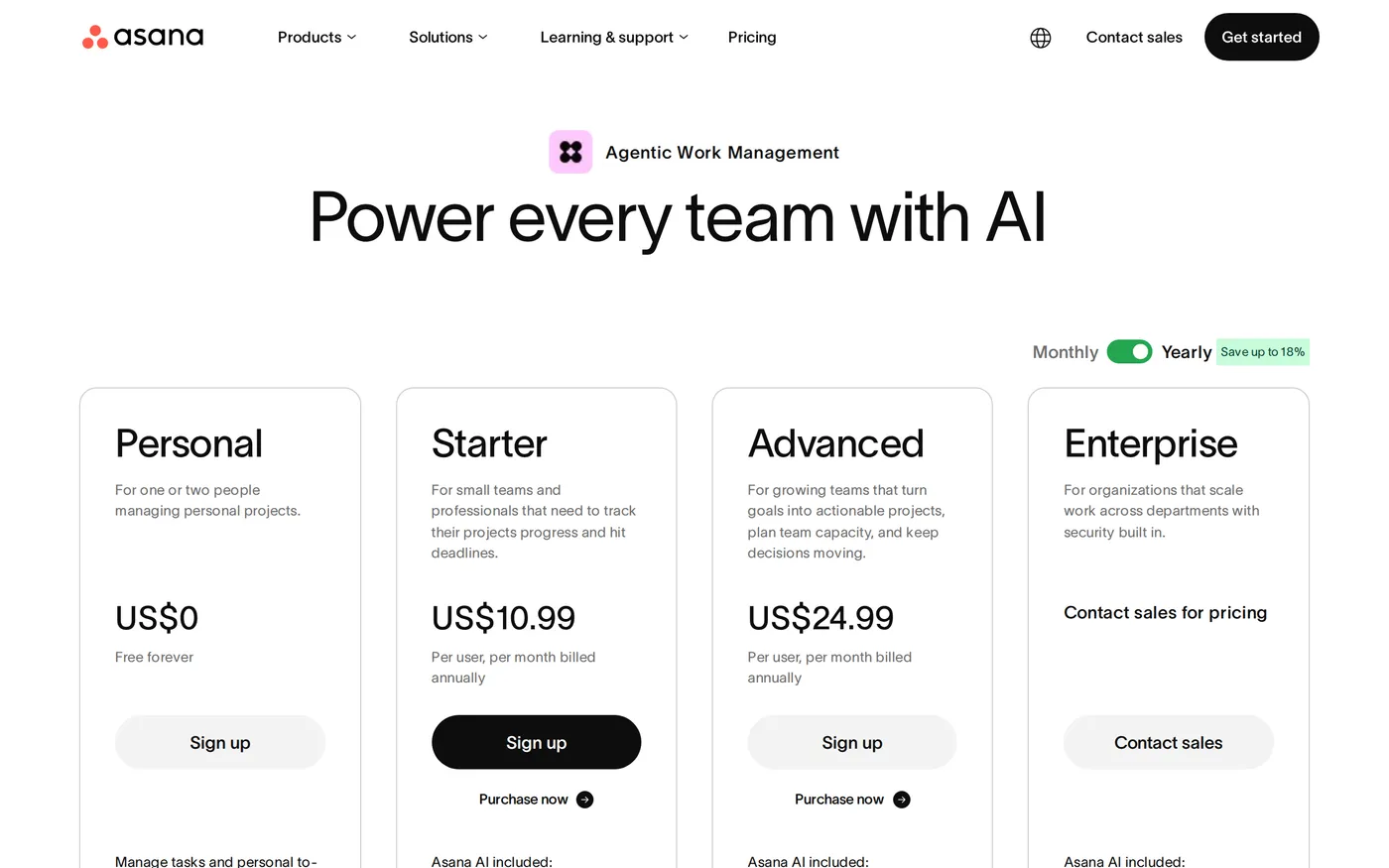
Starter is $10.99 per user per month on annual billing and $13.49 month to month — a 23% penalty for staying flexible, which is at the harsh end of normal. For that you get unlimited tasks and projects, the list, board and calendar views, and, importantly, Timeline and Gantt. Very few competitors put a real dependency-aware timeline on their entry paid tier; ClickUp does, Trello does not until Premium.
You also get unlimited automations, forms, custom templates and reporting dashboards, plus unlimited free guests. That last one matters more than it sounds. If your work involves clients, contractors or a partner agency, guest seats are where competitors quietly recover the discount they advertised.
The free Personal plan is capped at two users and 100MB of storage. Call it what it is: a demo. Asana is not competing at the free tier and has stopped pretending to.
The Advanced jump, and why it is not a rip-off
Going from Starter to Advanced takes the seat cost from $10.99 to $24.99 annually — a 127% increase. On a 40-person team that is roughly $6,700 a year of additional spend. It is the single most consequential decision in buying Asana, and the vendor does very little to help you make it.
What crosses the line: unlimited portfolios, goals, workload and resource management, approvals and proofing, form branching, time tracking, and the Salesforce, Tableau and Power BI connectors. Strip away the marketing and the real purchase is portfolios: a live rollup of many projects into one status view that a manager can read in ninety seconds. If that view removes a weekly status meeting for eight people, Advanced pays for itself. If nobody in your organisation is accountable for more than one project at a time, it does not, and you should stay on Starter indefinitely.
Where the reporting stops
Asana's dashboards are good at the questions Asana anticipated — tasks by assignee, overdue by project, completion over time — and stubborn about anything else. There is no arbitrary query layer. Teams that want to ask an unusual question end up exporting to a spreadsheet or paying for the Advanced-tier BI connectors and doing it in Tableau. For a product this expensive, the reporting ceiling arrives early.
Day-two administration
This is Asana's quiet strength. Its permission model is comprehensible: teams contain projects, projects have members, guests see only what they are added to. After a year, an Asana workspace is usually still navigable. The equivalent ClickUp workspace usually is not, because ClickUp lets every team invent its own hierarchy and most of them do.
Rules — Asana's automation — are deliberately simple. A trigger, a condition, an action. You will hit the ceiling on anything genuinely complex, and then you will reach for Zapier. That is the right trade for most teams: an automation layer a project lead can maintain beats one that requires a specialist and breaks silently.
The AI question
Every paid plan now includes Asana AI, with request limits and AI Studio credits that vary by tier. The features that work are the boring ones: summarising a long comment thread, drafting a project brief, flagging tasks that look stalled. The features sold hardest — autonomous AI teammates that run a workflow — require enough configuration that you are effectively building software, and the credit meter runs while you learn.
Treat AI credits the way you would treat any metered resource: assume you will exhaust them during the first month of enthusiasm, and check what the overage costs before you build anything load-bearing on top.
Who should not buy Asana
Teams under ten people running one project. Trello at $5 a seat does this, and does it with less ceremony.
Engineering teams. Asana has no opinion about branches, pull requests or releases. Linear and Jira do.
Anyone who needs custom reporting. You will hit the dashboard ceiling within a quarter and resent paying Advanced prices for the privilege.
Organisations that want one tool for everything. That is ClickUp's pitch, and it is a different trade: more surface, more entropy.
The verdict
Asana is the most disciplined product in this category. It has resisted the temptation to become a document editor, a chat app and a CRM, and as a result it is still legible after two years of use — which is more than can be said for most of its competitors.
Buy Starter if you need a timeline. Buy Advanced only if a named person is accountable for a portfolio of projects and would use the rollup weekly. There is no third reason.
The score reflects that clarity, minus the tier structure. Charging 127% more for the feature that defines the product is a pricing decision, not a product one, and it pushes small teams toward the cheaper tool they should probably have bought anyway. Full plan details are on Asana's pricing page, and they change more often than the marketing suggests.
Softmarque is not paid by the products it reviews. Prices and plan names were taken from the vendor’s own pricing page on the date shown above and change often; nothing here is financial, legal or accounting advice.