
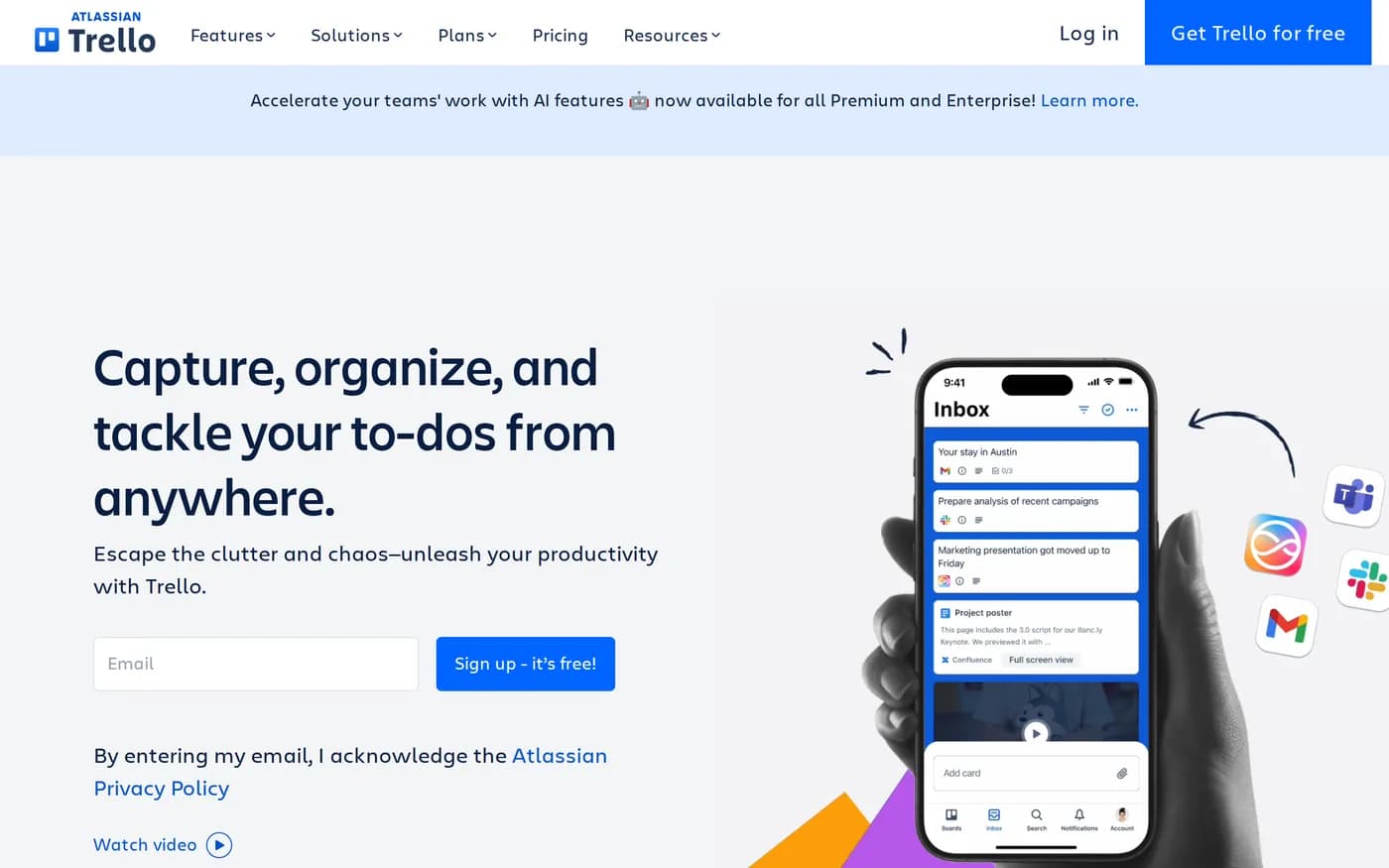
Every few years someone writes that Trello is finished — too simple, out-manoeuvred by tools that do twenty things. Then you watch a new starter open a Trello board and start working without being told anything, and the argument looks different.
The case for a tool that refuses
Trello is a board. Lists across, cards down, drag them. That is the entire mental model and it has survived twelve years and an Atlassian acquisition largely intact. The competitive advantage is not a feature; it is the absence of a training session.
Measure that honestly. If adopting a work tracker costs you two hours per person in onboarding across forty people, that is a week of salary before anybody has tracked anything. Trello's cost there is close to zero, and no comparison table has a column for it.
The free plan, and the limit that actually binds
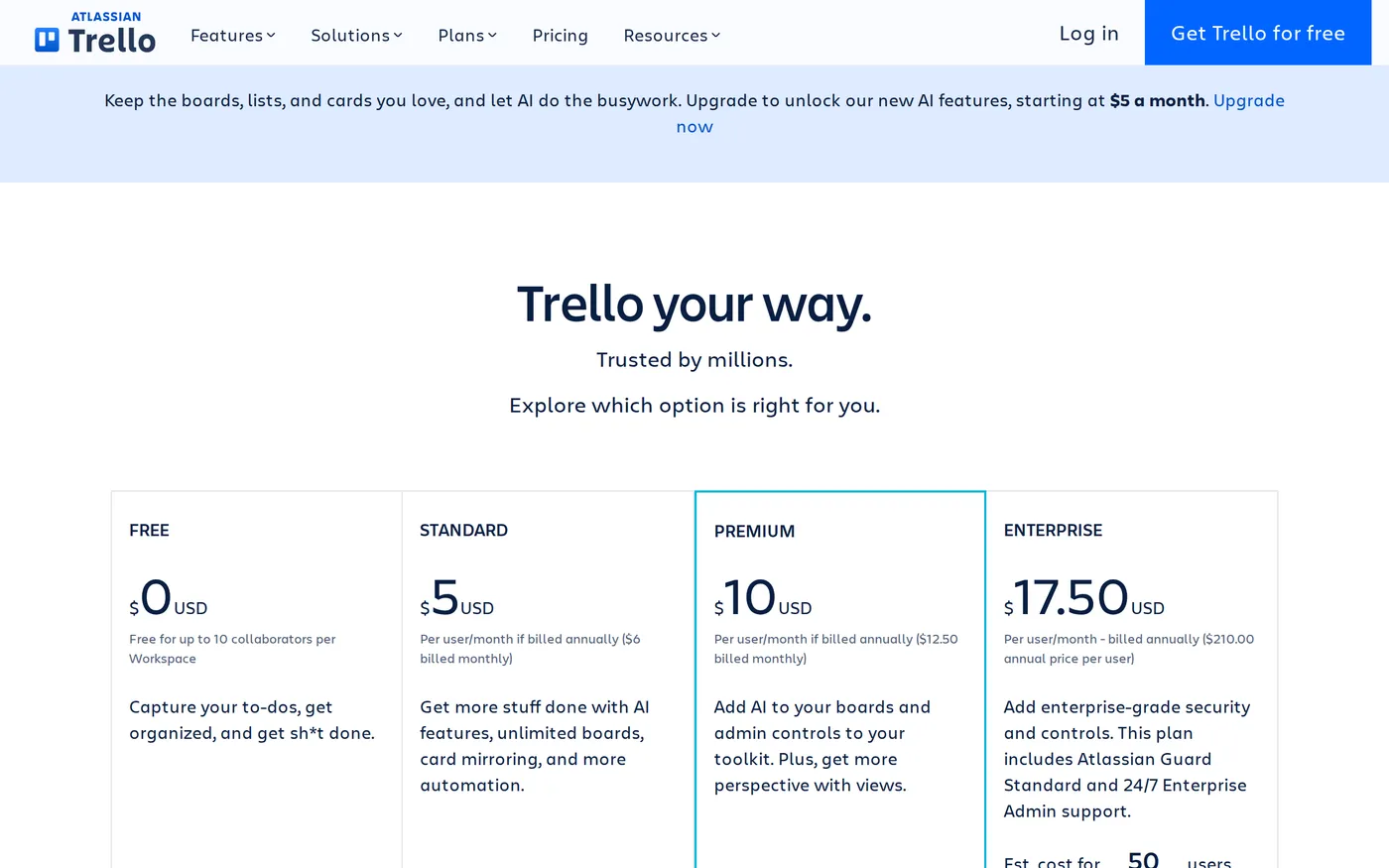
Free gives you up to 10 boards per Workspace, unlimited cards, unlimited storage and a Power-Up per board. That reads generously and behaves restrictively, because ten is small the moment boards stop being projects and start being views of things.
In practice: one board per client, one per quarter, one for hiring, one for the website rebuild, one for a conference — you reach ten in a quarter. The limit is per Workspace, so the workaround is more workspaces, and the workaround is worse than paying.
Standard at $5, and the feature that justifies it
Standard is $5 per user per month annually, $6 monthly. Unlimited boards, custom fields, advanced checklists, more automation, and card mirroring.
Mirroring is the one to understand. It lets a single card appear on several boards without becoming several cards. Before it existed, every team using Trello at scale invented some copy-and-hope convention and every one of them drifted out of sync. Mirroring fixes a real structural problem for five dollars, which is the best value in this review.
Premium at $10: buying the views
Premium doubles the price to $10 annually ($12.50 monthly) and the headline purchase is views: Calendar, Timeline, Table, Dashboard and Map, plus workspace-level templates and admin controls.
This is where the comparison gets awkward. Asana includes a dependency-aware Timeline on its $10.99 Starter tier. ClickUp includes unlimited Gantt charts at $7. Trello's Timeline is a visualisation of dates on cards, not a scheduling engine — move one card and nothing downstream moves with it.
If you need a timeline because you have dependencies, Trello Premium is not the product you are looking for. If you need a timeline because someone wants to see the quarter on one screen, it is fine and it is cheaper.
Enterprise, briefly
Enterprise is $17.50 per user per month billed annually — $210 per user per year — and bundles Atlassian Guard Standard, organisation-wide permissions, public board management, multi-board guests and SSO.
At that price you are paying more than Asana Starter and roughly ClickUp Business plus change, for a product that is deliberately less capable. It makes sense in exactly one situation: you are already an Atlassian estate, Guard is a line you have to pay anyway, and consolidating vendors is worth money to you. Outside that, it is the weakest tier in Trello's range.
Where Trello genuinely runs out
Dependencies. There is no real critical path at any tier. If work item B cannot start until A finishes, Trello will not help you.
Workload. No capacity view. You cannot see that one person holds forty cards and another holds four without counting.
Reporting across boards. Premium dashboards are per-board. Portfolio-level questions need a Power-Up or an export.
Approvals. Not a concept. People use labels and hope.
Verdict
Trello is the most honest product in this category. It knows what it is, it prices accordingly, and it has not tried to bolt on a document editor to compete on feature count.
Buy Standard at $5 if you have outgrown ten boards — mirroring alone repays it. Buy Premium only if a named person wants a calendar or a table and will actually open it. Skip Enterprise unless Atlassian Guard is already on your invoice. Plan details are on Trello's pricing page.
Softmarque is not paid by the products it reviews. Prices and plan names were taken from the vendor’s own pricing page on the date shown above and change often; nothing here is financial, legal or accounting advice.